NATION Newspaper Celebrates Itself While Press Freedom Concerns Persist

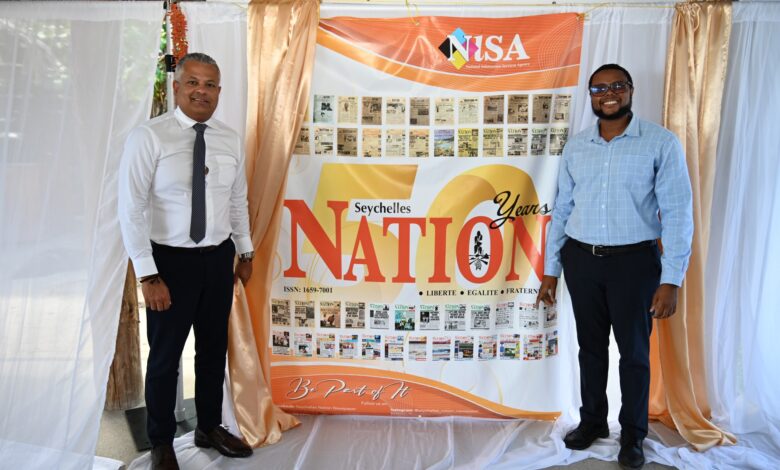
Beau Vallon, Seychelles – The government-owned Seychelles NATION newspaper held a lavish ceremony on Thursday to unveil its 50th anniversary logo, an event presided over by Vice-President Sebastien Pillay that critics say highlights the uncomfortable relationship between state media and political power in Seychelles.
The celebration at Augerine in Beau Vallon featured performances, speeches, and the launch of a commemorative jingle by Debra Damoo, accompanied by the Dynamite Crew dance troupe. While NATION’s 50-year history since independence in 1976 is noteworthy, the event’s timing – just days before World Press Freedom Day on May 3 – has not gone unnoticed by media watchdogs.
State Media, State Message
In his address, Gerard Govinden, Chief Executive of the National Information Services Agency (NISA), emphasized NATION’s role as “the living memory of our people” and praised its evolution into digital platforms. However, he made no mention of editorial independence or the outlet’s relationship with government.
The newspaper, produced by NISA – a government agency – has long faced accusations of serving as a propaganda tool rather than an independent news source. The 50th anniversary celebration, funded by taxpayers and attended by the Vice-President, only reinforces this perception.
“When your newspaper’s anniversary is presided over by the Vice-President, you have to ask: who are they really serving – the public or the government?” asked a local journalist who requested anonymity. “True press freedom means being able to hold power accountable, not celebrate alongside it.”
World Press Freedom Day: Ironic Timing
The fact that this government media celebration occurred just days before World Press Freedom Day (May 3) struck many as either tone-deaf or deliberately provocative. While Govinden spoke of NATION “engaging audiences in real time” and “reaching younger generations,” he avoided addressing the fundamental question: can state-controlled media ever truly serve the public interest?
Independent media outlets in Seychelles continue to face challenges, including limited access to government information, advertising pressure, and what some describe as a hostile environment for investigative journalism.
Digital Transformation or Digital Control?
Much was made of NATION’s digital evolution, with Govinden highlighting the newspaper’s online presence and social media engagement. “In today’s fast-moving world, news is no longer confined to print,” he stated.
Yet critics point out that digital transformation of state media simply means more platforms for the same government-friendly messaging. The question isn’t whether NATION has websites and apps, but whether it provides the independent, critical journalism that democracy requires.
A Celebration of What, Exactly?
The event featured poetry by Katrina Zialor, musical performances, and was attended by NISA staff and guests, culminating in a lunch celebration that coincided with Labour Day (May 1) and World Press Freedom Day observances.
While 50 years of publication is certainly a milestone, some question whether this is cause for celebration or reflection. Has NATION served as a watchdog holding power accountable, or has it functioned as a government mouthpiece for five decades?
The elaborate anniversary logo, jingle, and ceremony suggest the government wants to project an image of a vibrant, modern media outlet. Whether NATION’s journalism matches this image is a question the anniversary celebrations conveniently avoided.
As Seychelles marks this media milestone, the fundamental challenge remains: how can true press freedom flourish when the nation’s most established newspaper is controlled by the very government it should be scrutinizing?