SeyCCAT Launches Seagrass Monitoring Protocols – Protecting the Blue Carbon Asset Most Seychellois Have Never Heard Of

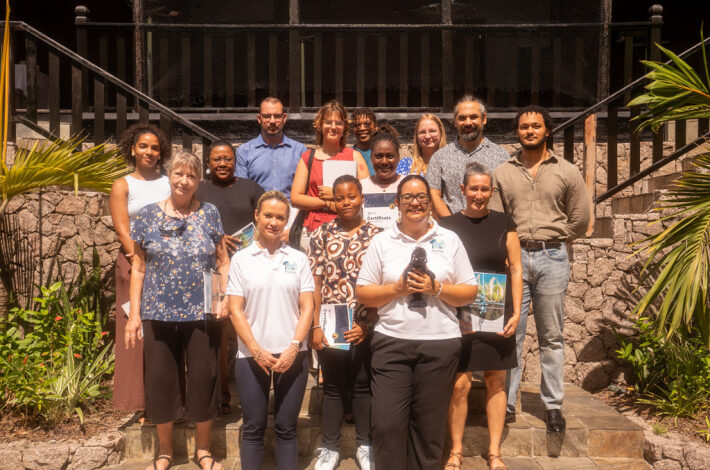
Victoria, Seychelles – The Seychelles Conservation and Climate Adaptation Trust officially handed over the nation’s new Seagrass Assessment, Monitoring and Restoration Protocols on April 30, along with a practical Seagrass Identification Flipchart and certificates for 18 trained practitioners from across government and non-governmental organisations.
It is a story that deserves far more attention than it typically receives.
Seagrass meadows covering 1,599.2 square kilometres across Seychelles’ Exclusive Economic Zone account for 96 percent of the country’s blue carbon stock. Those meadows store an estimated 18.9 million tonnes of organic carbon – the equivalent of approximately 69 million tonnes of CO2. Their annual sequestration rate of around 510,000 tCO2e offsets emissions roughly equal to Seychelles’ entire energy sector.
In plain terms: seagrass is doing more for Seychelles’ climate position than almost any other single asset in the country. It is also invisible to most of the population.
The protocols developed by Bee Ecological Consulting provide Seychelles with a standardised, scientifically robust framework for tracking the health of these meadows consistently over time. SeyCCAT’s chief executive Helena Sims noted that the system is essential not only for NDC reporting and the Marine Spatial Plan, but for the long-term policy decisions that will determine whether these ecosystems are protected or degraded.
The Seagrass Identification Flipchart, created by Dr Jeanne Mortimer, addresses a practical gap – enabling field practitioners to identify species accurately and collect consistent data across monitoring sites regardless of their academic background.
Eighteen participants were trained, drawn from Nature Seychelles, Island Conservation Society, Seychelles Parks and Gardens Authority, and the Seychelles Islands Foundation. The diversity of participating organisations reflects the collaborative approach that will be essential if the protocols are to be applied consistently rather than sitting in a folder.
This kind of quiet, technical conservation work rarely generates headlines. But the monitoring and protection of Seychelles’ seagrass meadows is as consequential for the country’s long-term climate resilience as any policy announcement – and it is happening largely outside public view. It deserves to be known.