Île Aurore Land Reclamation Project Proceeds Despite Middle East Delays

Victoria, Seychelles – The Île Aurore land reclamation project will proceed, President Patrick Herminie has confirmed, despite delays caused by ongoing instability in the Middle East.
The President made the announcement during his first live press conference at State House on Thursday May 7, speaking before members of the local press. He noted that the project, which was originally scheduled to commence by June 2026, remains a firm government priority. However, widespread global instability has forced a reassessment of the timeline.
“We remain fully committed to this project. This is a delay, not an abandonment,” President Herminie said, adding that government continues exploring additional possibilities around the project while maintaining its vision for Île Aurore.
Groundwork underway. Construction groundwork is already progressing on the ground at Île Aurore. Grading and earthmoving activities are actively underway as teams work to raise the terrain level to improve drainage and prepare the site for the construction phase. Heavy machinery and labour crews can already be seen clearing and shaping large sections of land ahead of the main reclamation works.
The first phase of the project, fully funded at 15 million euros, will yield 500,000 cubic metres of minerals for construction purposes. The extracted material will be stored on Île Aurore and managed through a dedicated control system, complete with a weighbridge to ensure accountability and transparency in its use.
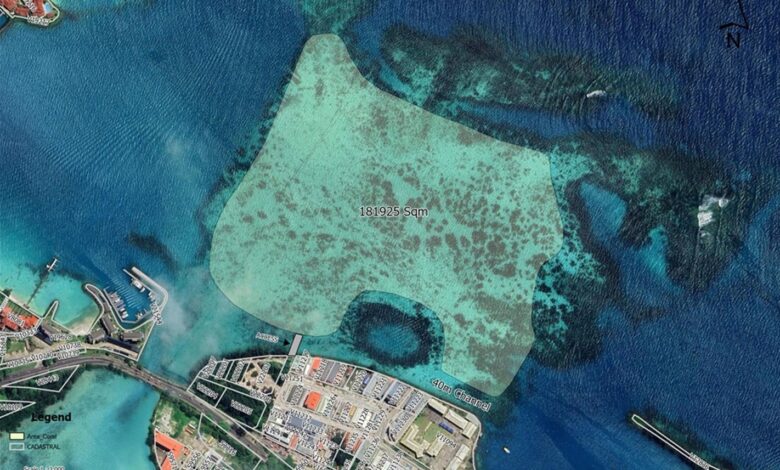
Upon completion, the project is expected to create more than 570,000 square metres of entirely new land. This reclaimed territory will accommodate approximately 1,800 housing units, around 1,000 of which will fall within the affordable housing category, along with schools, small business spaces and other essential infrastructure.
Affordable housing designs advanced. Plans for the affordable housing component are already well advanced. Under a bilateral agreement with the government of India, the designs for more than 1,000 affordable homes are currently at an advanced stage, allowing construction to proceed once the land is ready.
The ongoing Middle East conflict has had tangible consequences for global maritime operations. Jan De Nul, which maintains a significant operational presence across the Gulf region, has experienced considerable disruption to its vessel scheduling and supply chains as a result of the regional instability.
Despite the delay, officials confirmed that the contractual framework established in January remains fully in force. Both the government and Jan De Nul are working closely to establish a revised operational timeline, with a view to resuming works at the earliest possible opportunity.
What the delay exposes, beyond the technical logistics, is the vulnerability of small states to forces entirely beyond their control. A conflict thousands of kilometers away disrupts dredging schedules in Seychelles. The reclamation will proceed eventually, but the pause is a reminder that even national priorities must sometimes wait for the world to settle.