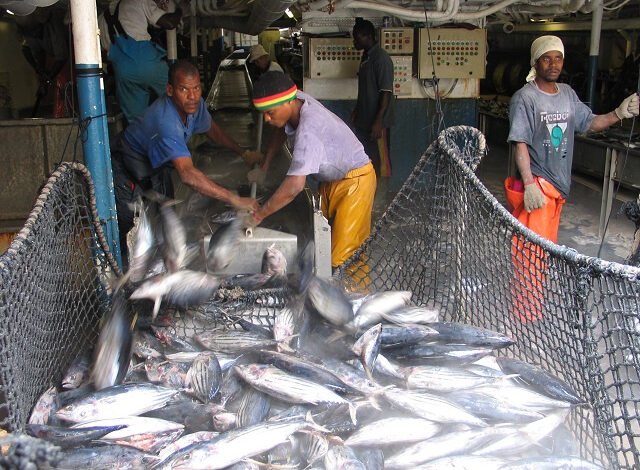
📷 Photo: Joe Laurence, Seychelles News Agency, via Wikimedia Commons, CC BY 4.0
VICTORIA, Seychelles — A delegation from the Republic of the Marshall Islands arrived in Seychelles this week for a study visit aimed at understanding the legal framework and operational model behind Seychelles’ fisheries sector, with a particular focus on port development, value-added tuna production, and public-private partnerships.
The delegation paid a courtesy call on the Minister for Fisheries and the Blue Economy, Wallace Cosgrow, at Maison Collette yesterday. Following the meeting, secretary of state for fisheries Alain Decommarmond and chief fisheries officer Beau Bilger outlined the purpose of the visit and its expected outcomes to the press.
According to Decommarmond, the visit follows discussions held just over a month ago between Minister Cosgrow and the President of the Marshall Islands, who expressed interest in learning from Seychelles’ experience in fisheries. “They want to understand Seychelles’ legal framework and how we work with industrial operators and the private sector. Seychelles is well established in value-added fisheries, and they want to learn from our experience,” he said. He added that the visit benefits the Marshall Islands while also opening the door for future cooperation, including potential industry partnerships and cooperation in marine security.
Bilger said the visit was motivated by the Marshall Islands’ ambition to expand its onshore tuna processing industry and create greater value within its own fisheries sector. “We know Seychelles is one of the world’s most successful fishing nations, with strong port facilities, value-added projects, and financing mechanisms under the blue economy. We hope to draw lessons from these experiences and adapt them to our own context,” he said. Bilger noted that both countries are small island developing states facing similar constraints, including limited land space and logistical challenges in reaching distant markets. Fisheries account for between 60 and 70 percent of the Marshall Islands’ gross domestic product, making it the country’s main economic pillar, with the remainder of the economy relying largely on foreign aid, primarily from the United States.
The Seychelles government’s broader push to expand returns from fisheries is set out in the 2026 Budget Speech and reinforced in the country’s ocean diplomacy at the Island States Ocean Summit in Japan, where the Ministry of Fisheries and the Blue Economy showcased progress on fisheries management, marine conservation and sustainable ocean governance. The World Bank Group’s 2026 Seychelles review similarly highlights the blue economy as a long-term driver of jobs and resilient growth.
During their stay, the Marshall Islands delegation is scheduled to hold meetings, technical discussions and site visits with government institutions and stakeholders in fisheries, the blue economy, marine conservation, port operations and sustainable ocean governance. The delegation will also meet officials from the Department of Fisheries and the Department of Blue Economy to exchange experiences on sustainable management and development. Bilger said the visit is expected to strengthen cooperation between Seychelles and the Marshall Islands while promoting the exchange of expertise in fisheries development, sustainable ocean governance and the blue economy.
Sources cited: Ministry of Fisheries and the Blue Economy, Seychelles – Ocean leadership at the Island States Ocean Summit in Japan. Ministry of Finance, Seychelles – 2026 Budget Speech. World Bank Group – Smart resilient investments key to jobs and growth in Seychelles.
Source: SN