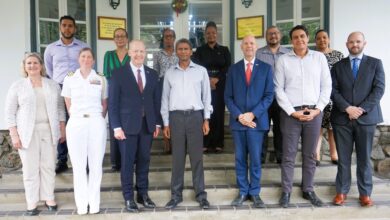
VICTORIA, Seychelles — A delegation from the International Labour Organization (ILO) met Employment and Human Resource Planning Minister Idith Alexander this week to advance work on a national living wage, a process the government has framed as the next step beyond the country’s existing minimum wage.
The ILO team was led by Nicolas Maitre, an economist with the organisation’s wages and social dialogue unit, and Ernest Ngeh Tingum, a wages and social dialogue specialist, according to a press release issued by the Ministry of Employment and Human Resource Planning and reported in the 4 July 2026 edition of Seychelles Nation. They were joined by members of a Living Wage Technical Working Committee that the ministry has set up to oversee the calculation.
A living wage, in the ILO’s own definition, is the level of pay that allows a worker and their family to afford a decent standard of living — covering food, housing, healthcare, education, transport and a margin for social participation — based on robust data and negotiated with employers’ and workers’ organisations. The methodology the agency shares with governments is set out in detail on the ILO’s living wages portal.
The Seychelles process began earlier in 2025, when the Cabinet approved the introduction of a living wage framework. The work is being coordinated by the Ministry of Finance, Economic Planning, Trade and Investment, with the Ministry of Employment and Human Resource Planning as co-chair, the press release said.
Methodologically, the calculation will rest on a basket of essential goods and services calibrated to a standard-size Seychellois family. The technical committee will initially draw on the 2018 Household Budget Survey and update the figures once the 2024–2025 Household Budget Survey becomes available, the ministry said.
The ILO’s role is twofold: to provide the methodology and technical training for the calculation, and to back the social-dialogue process that will validate the final figure. The agency is also supporting the drafting of the report that will be presented to stakeholders.
For workers, the practical difference between a minimum wage and a living wage is meaningful. A minimum wage sets a floor below which pay cannot fall; a living wage is intended to reflect what a household actually needs to live decently. Globally, the ILO estimates that about 50 per cent of wage workers in low-income countries are paid below a living-wage threshold, and that 327 million workers worldwide earn less than the legal minimum wage.
Seychelles’ most recent minimum-wage adjustment took effect in April 2025 and raised the hourly minimum wage for non-casual workers from SCR 38.27 to SCR 40.95 and for casual workers from SCR 44.10 to SCR 47.19. WageIndicator, which tracks minimum-wage data globally, published the new rates. The adjustment was described by the Ministry of Finance at the time as informed in part by living-wage assessments, but no final living-wage figure has yet been published.
For Seychelles, the stakes are unusually high. The country imports the bulk of its food and consumer goods, and household budgets are particularly exposed to global price swings. A living wage calibrated to local costs — rather than indexed to a regional benchmark — would give employers, trade unions and policymakers a single, defensible number to anchor collective bargaining and public-sector pay.
The technical working committee has not said when the calculation will be completed or when a draft living-wage figure will be published. The press release said only that the work is being carried out through a participatory approach involving government institutions, employers’ and workers’ organisations, and other key national stakeholders.
📷 Photo: Henk Monster via Wikimedia Commons, CC BY 3.0
Sources cited: International Labour Organization, Living Wages topic page,. WageIndicator, “Seychelles minimum wages 2025”,. Seychelles Cabinet decision, May 2025.
Source: SN