
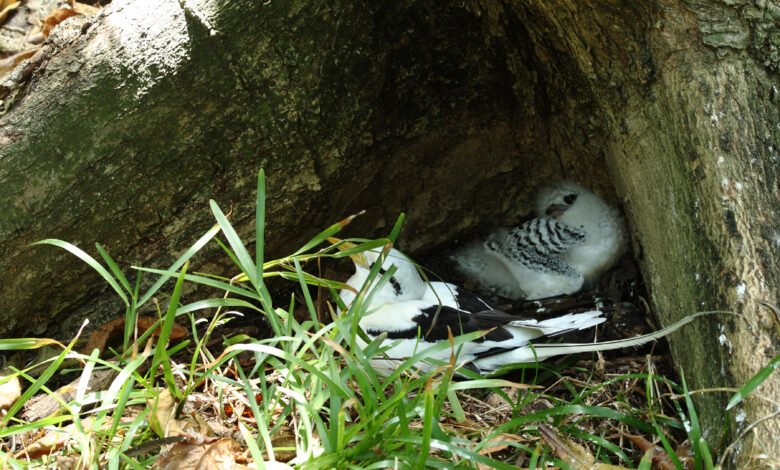
📷 Photo: Wikimedia Commons, Ile Aride — Oiseau (19), CC BY-SA
VICTORIA, Seychelles — Researchers have begun a new season-by-season tracking study of white-tailed tropicbirds on Aride Island, aiming to produce the first full-year picture of how the Seychelles’ most familiar seabird feeds across both monsoons.
The project is a collaboration between the Island Conservation Society (ICS), the University of Seychelles’ Island Biodiversity and Conservation Centre, and the Norwegian Institute for Nature Research (NINA), and is anchored at Aride, the privately managed nature reserve in the inner granitic islands that hosts the largest breeding colony of the species in the Western Indian Ocean.
Until now, published tracking work on the species in Seychelles has concentrated on the austral summer monsoon between November and April, when the dominant winds are lighter and from the northwest, with waters less productive than in the winter monsoon but more accessible from shallow colonies. The earlier marine ecology research by Ensanyar-Volle and colleagues, published in Marine Ecology Progress Series under the lead of NINA seabird biologist Dr Annette Fayet and University of Seychelles researcher Dr Gerard Rocamora, showed that Aride birds travel about twice as far on average as their cousins at Aldabra, 1,200 kilometres to the south-west, and that both populations feed largely outside any protected area drawn around their colonies.
That earlier work, whose tracking data is hosted on the Seabird Tracking Database, left a clear gap: the southern hemisphere winter months between May and September, when the south-east monsoon brings stronger winds and colder, more productive waters, were effectively off the map. The new study on Aride aims to close it.
“The first paper covered what happens when it is calm and the sea is warmer than average, but we have never had a comparable picture from the winter monsoon, when the wind is strong and the water is much richer,” a researcher familiar with the project said. “Birds that depend on the trade winds, on cool upwelling-driven productivity, or on prey that migrates with the season, may well behave very differently.”
Working out of the Aride ranger station, the team is deploying miniature GPS loggers weighing under three per cent of the birds’ body mass on breeding adults in both seasons and is pairing the deployments with ringing, blood sampling and chick-monitoring work. Alongside the field work, the team is providing hands-on training for ICS conservation staff in seabird handling, ringing, biometric measurement and GPS-tracking techniques, building a permanent capacity on the island to monitor seabirds year-round.
Dr Jennifer Appoo, lecturer in ecology and conservation at the University of Seychelles, who is coordinating the University of Seychelles side, said the seasonal comparison is one of the project’s central scientific aims. Mersiah Rose, science and conservation officer at ICS, said the in-residence training would strengthen the reserve’s ability to keep detailed monitoring records between research visits.
The work is being conducted under a Seychelles Biodiversity Research permits framework and under the lease arrangements on Aride, which ICS has managed since 1975. The reserve is a key stopover in the BirdLife International Important Bird Areas network and supports colonies of several other seabird species, including the wedge-tailed shearwater, fairy tern, roseate tern and the Seychelles-endemic Seychelles kestrel.
The white-tailed tropicbird itself is currently classed as a species of Least Concern by the International Union for Conservation of Nature, but its population in parts of the Western Indian Ocean is declining, and conservationists say that understanding where the birds feed in each season, and how this interacts with industrial fishing, shipping lanes and emerging offshore development, is essential for protecting both the species and the broader marine ecosystem on which it depends.
Initial findings are expected to be published in 2027, with the Seychelles research team aiming to make the full tracking dataset publicly available through BirdLife’s Seabird Tracking Database.
Sources cited: Marine Ecology Progress Series — Differences in foraging range between white-tailed tropicbirds breeding on inner and outer Seychelles islands; Seabird Tracking Database — Uncovering the foraging movements of White-tailed Tropicbirds in the Western Indian Ocean, 12 February 2024; University of Seychelles — about the university; BirdLife International DataZone — Seychelles country profile; White-tailed tropicbird (Wikipedia).