State House Clarifies Presidential Pardons, Drug Policy, Security Matters, and Related Issues

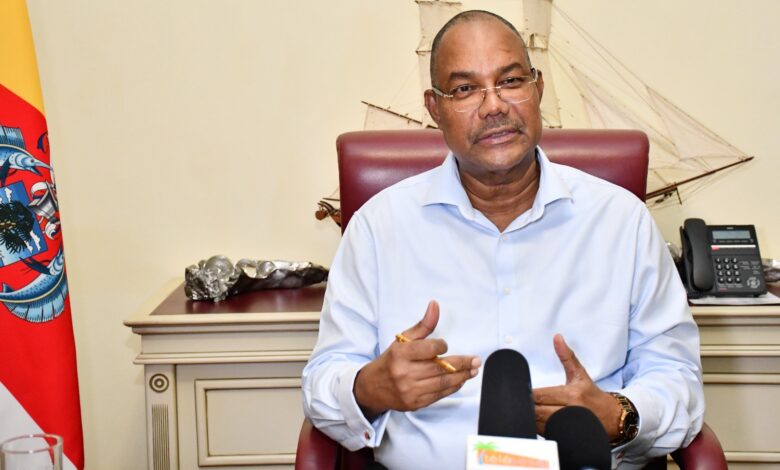
Photo credit: Seychelles Nation
President Dr. Patrick Herminie met with representatives of various media houses to address a range of issues currently dominating public discourse. During the engagement, the President provided clarifications on presidential pardons, the government’s drug policy, national security matters, and other related concerns that have been at the forefront of public attention.
Who are the prisoners who were granted presidential pardons, how many are they, and on what grounds were they pardoned?
Firstly, it is important to clarify how the presidential pardon process works. The President does not have the sole authority to grant a pardon independently. A pardon can only be issued following recommendations from a designated committee.
In this case, the committee initially made three recommendations. These concerned two individuals convicted of drug trafficking and one individual convicted of murder. All three pardons were approved on humanitarian grounds.
Of the three cases, the first individual has reached a medical stage where treatment must be conducted overseas. Discussions were held with the Indian authorities and the police, and the feedback received was that the individual must be a free man to undergo the required medical procedure. His condition was critical, involving the possibility of treatment or amputation of his legs, which were injured during the prison riot last year. It should be recalled that this individual was a victim of that riot. The security of inmates falls under the responsibility of the prison service. Preliminary reports indicate that the bullets used during the riot were similar to those used by the previous security team, locally known as Ibou.
The second individual is terminally ill. As a medical doctor, I have reviewed and acknowledged that his condition is irreversible. He has only a few months to live, and a decision was taken to allow him to spend his remaining time with his family.
The third individual was due for release in February this year. He also had medical and humanitarian considerations that justified the granting of a pardon.
In addition to these three cases, two other individuals were recently granted pardons on the basis that they did not receive a fair trial. These cases are linked to the alleged bombing incident in Grand Anse. There is a serious injustice involved, and this morning I sought legal advice on the possibility of a retrial.
Some members of the public say the government is fighting drugs while releasing prisoners convicted of drug-related offences. What is your response?
Our position with regard to illicit drugs remains firm. In fact, we are working to implement several measures aimed at combating both drug trafficking and drug demand. These plans have always existed, but over the past five years they were sidelined. As a result, to date, we still do not have adequate rehabilitation centres or tangible programmes in place.
With regard to trafficking, we will be restructuring the system. The Organised Crime Unit (ex-Anti-Narcotics Bureau – ANB) and the Financial Crime Investigation Unit (FCIU) will be placed directly under the Office of the President, governed by their own legislation, and removed from police oversight.
One of the biggest challenges in the fight against drugs is corruption, which continues to encourage the proliferation of narcotics. There are police officers who are currently involved with traffickers. If we are not careful, Seychelles risks becoming a narco-state.
It must also be emphasized that all pardons are conditional. If any of the individuals reoffend, they will be returned to prison to serve the remainder of their sentence.
What is the government’s position on legalizing marijuana for recreational use?
The government has not yet taken a decision on this matter, nor has it been formally discussed. This issue requires a national debate, as there are differing views within society. From a medical perspective, I would not recommend it. However, the views of the public must be considered, after which the relevant bodies will decide. A referendum could be considered if necessary.
Why was the Kenyan national, Nassim Anwar Onezime, granted temporary permission to return to Seychelles following her deportation from the country by the previous administration?
She was granted permission to return in order to represent herself and defend her case. Her situation is more complex than many people realize. She was forced out of the country despite having no wrongdoing recorded under her Prohibited Immigrant (PI) status.
She has since filed a case against the Commissioner of Police. Additionally, a case was brought before the African Court of Justice. Seychelles did not have representation before the court, and by default, Nassim won her case.
If there had been concrete evidence that she was a drug trafficker, proper investigations should have been conducted at the time of her apprehension. The logical first step would have been to seize her phone and carry out the necessary forensic extraction. This was not done. The question therefore arises as to why she was not brought before a court in Seychelles.
Former President Wavel Ramkalawan has claimed that he is being targeted following a decision to seize arms and vehicles assigned to his security. What is your response?
If the former president wishes to be respected, he must also respect the privacy of others. He cannot be sending agents to walk around filming and following me wherever I go. Even my private residence has been posted on Facebook.
We cannot allow his bodyguards to be involved in activities that may be unlawful. Such actions disrespect the Office of the President and, more importantly, compromise presidential security. The release of videos showing access points to my residence is extremely concerning. An investigation is currently underway to determine how this occurred.
As part of this investigation, it was found necessary to withdraw firearms from his security personnel. A joint decision was taken with the Defence Forces that, with immediate effect, military officers will be responsible for his security. There is a tendency for former presidents to retain personal security arrangements. If this is not properly managed, it could lead to serious security risks in the future. There is only one Commander-in-Chief, and it is the Chief of Defence Forces who decides who guards a former president, similar to systems such as the United States Secret Service.
At my own residence, I do not know which officers will be guarding me on a daily basis. The faces change regularly. I must trust the process and have confidence that the CDF deploys well-trained personnel.
What about the issue of transport provided to the former president?
The vehicle assigned to him was withdrawn for maintenance purposes. An alternative vehicle was offered, a brand-new RAV4, which he refused. There have also been instances where my wife and children have been followed, and this must stop. Presidents Faure and Michel did not behave in this manner towards him. He must accept that he lost the election and wait until 2030 if he wishes to contest again.
Statements made by LDS regarding a potential coup d’état in 2027 are also under investigation. This morning, one of his bodyguards was apprehended after threatening a police officer. The same bodyguard is allegedly linked to the premeditated coup plot. However, his actions will be dealt with under military law.
Despite these developments, it is important to note that a former president remains entitled to security personnel for the rest of his life.
Following the release of a video allegedly showing ways to infiltrate your residence, the former president has urged the public to pay attention to government decisions taken against him. What is your response to public concerns about maintaining peace in the country?
The former president is struggling to accept his electoral defeat and, as a result, is beginning to sow division and hatred in the country. We are aware of fake social media profiles that are spreading misinformation on a daily basis, and these will be addressed.
The government is not paying for my accommodation at Eden Island, nor for renovations taking place at my house. These are false rumours intended to mislead the public and foster resentment. We cannot allow a situation where hatred is deliberately encouraged under the guise of political victimhood.