VICTORIA, Seychelles —
Seychelles is on track to switch on its first floating solar power plant later this year, with construction in the Providence lagoon now reported at 26 percent completion by the project’s lead contractors.
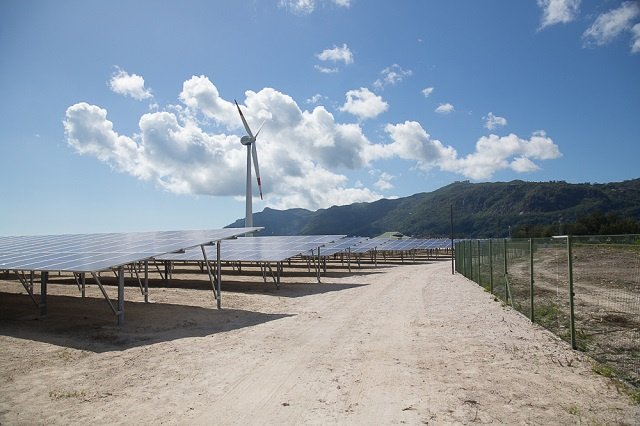
📷 Photo: Solar farm on Romainville Island, Seychelles, by Jude Morel, via Wikimedia Commons, CC BY 4.0
The 4 megawatt facility will sit on the water rather than on land, using roughly 10,000 photovoltaic panels rated at 590 watts each. Once fully commissioned it is expected to feed clean electricity into the national grid and cut the country’s dependence on imported diesel for power generation.
The project is being delivered by French renewable energy developer Qair together with Taylor Smith Naval Services and other local contractors. The choice of a water-based installation reflects two practical constraints familiar across the Seychelles: a small land area where ground-mounted solar competes with tourism and housing, and the cooling effect that water has on photovoltaic modules.
The wider floating solar sector has grown at an extraordinary pace over the past decade. Global installed capacity rose from about 1 gigawatt in 2018 to 13 gigawatts by 2022, according to the Wikipedia overview of floating photovoltaics, with the World Bank estimating that around 6,600 large bodies of water worldwide could host floating arrays with a combined technical potential of more than 4,000 gigawatts if just ten percent of their surfaces were used.
The Seychelles project remains modest in global terms but is one of the more closely watched in the western Indian Ocean. Island states in the region have been pressed to find indigenous renewable generation as a buffer against oil price shocks, currency volatility and shipping disruption. Diesel-fired plants have long set the marginal cost of electricity across the archipelago, and any new megawatt of solar capacity directly displaces a corresponding volume of imported fuel.
Floating arrays typically outperform land-based panels on energy yield. The cooling effect of water can lift efficiency by between 0.6 percent and 4.4 percent depending on the technology, and the panels shade the water below, slowing evaporation and reducing algae growth, useful side benefits on a freshwater reservoir and on coastal lagoons alike. Life-cycle analyses published in the same body of research suggest foam-based floating systems have some of the shortest energy payback times in the solar sector, at roughly 1.3 years.
Qair, which operates across more than twenty markets, has positioned Seychelles as a flagship project for its small-island portfolio. The Seychelles experience is also feeding back into other Indian Ocean tenders, where similar constraints apply.
Final commissioning of the Providence lagoon plant is expected in the coming months. Once on stream, the array will join the existing grid-connected solar installations already operating on the islands, including the Ile de Romainville Solar Park, and feed into a national push to lift the share of renewables in Seychelles‘ electricity mix.
Sources cited: Floating solar, Wikipedia. Qair news. World Bank floating solar documents. Ile de Romainville Solar Park, Wikipedia.
Source: SN