
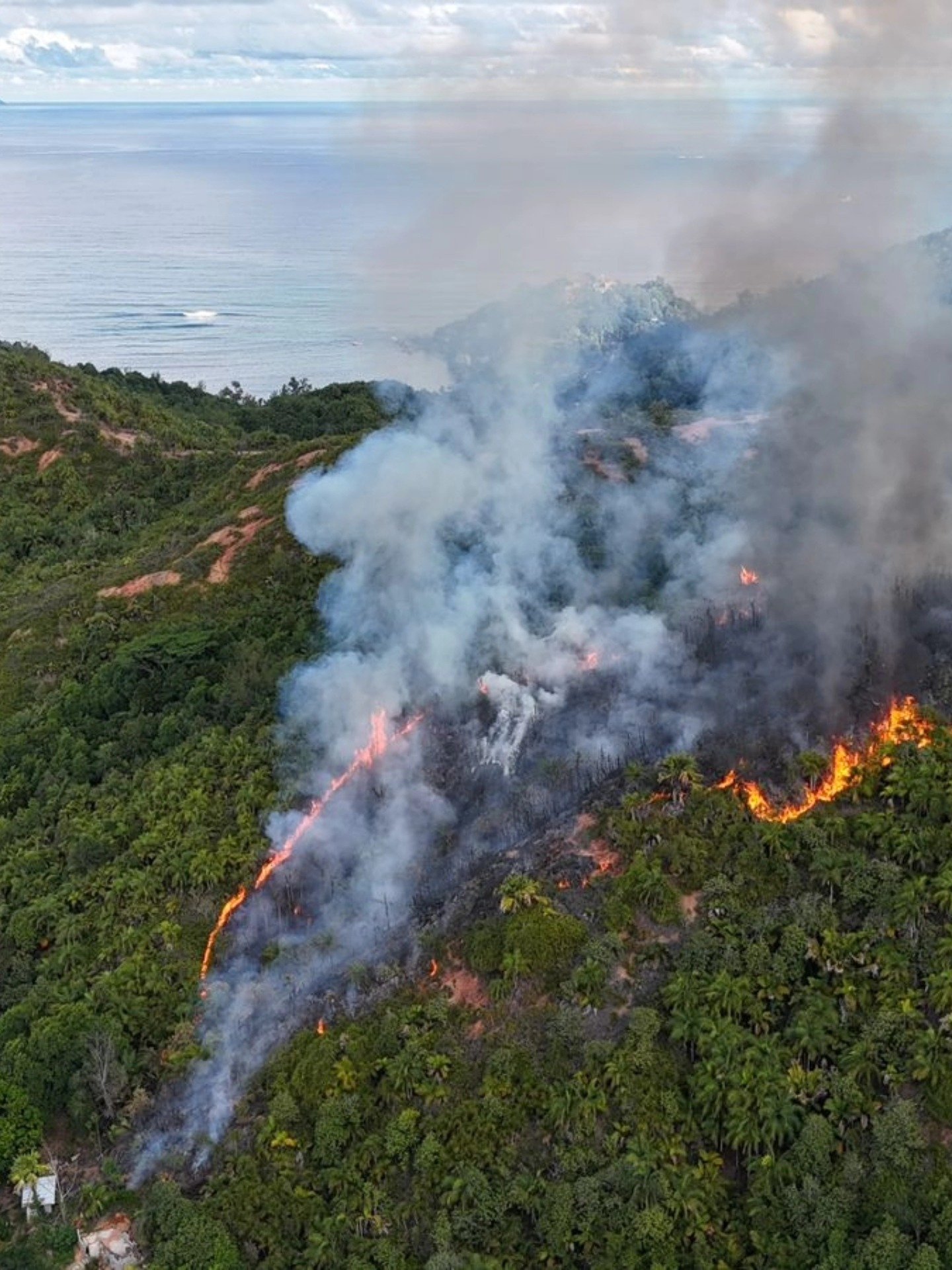
Praslin, Seychelles – The forest fire that tore through Fond Azore on Praslin was finally brought under control at around 6pm yesterday, after burning for more than 24 hours and destroying between 10 and 12 hectares of land home to key endemic species including coco de mer palm trees and vacoa.
The containment came through a combination of sustained human effort and nature’s intervention. Zil Air provided aerial water drops from around 7am, helping ease a fire that terrain and dry conditions had made exceptionally difficult to fight on the ground. A PUC water bowser supplied spray teams clearing firebreaks. Then, at around 5.30pm, approximately 20 minutes of heavy rainfall significantly suppressed the remaining flames.
Senior Environment Officer Shirley Joubert, who headed the incident command centre, confirmed there was no remaining risk of reignition before firefighters and volunteers were released from the site. SFRSA officers were scheduled to return today to assess the situation and carry out further evaluations.
The Ministry of Environment issued a statement expressing solidarity with Praslin residents and confirming that rehabilitation efforts would be undertaken in collaboration with the Seychelles Islands Foundation, the Seychelles Parks and Gardens Authority, and NGO partners.
The ministry also reiterated that a complete ban on open fires remains in force on Praslin and other islands due to prolonged dry conditions. Under the Lighting of Fires Restriction Act 2019, anyone who lights or authorises an open fire without a valid permit during an active fire ban commits an offence and may face fines of up to R500,000 or imprisonment of up to five years.
The cause of the fire is under investigation.
What burned in those 12 hectares cannot be replaced on any human timescale. The coco de mer is among the most iconic and irreplaceable species in the world. Endemic species that took centuries to establish burned in hours. The government has promised rehabilitation. The harder question – what prevention, what preparedness, and what enforcement of the fire ban would have changed the outcome – has not yet been asked publicly. It should be.


