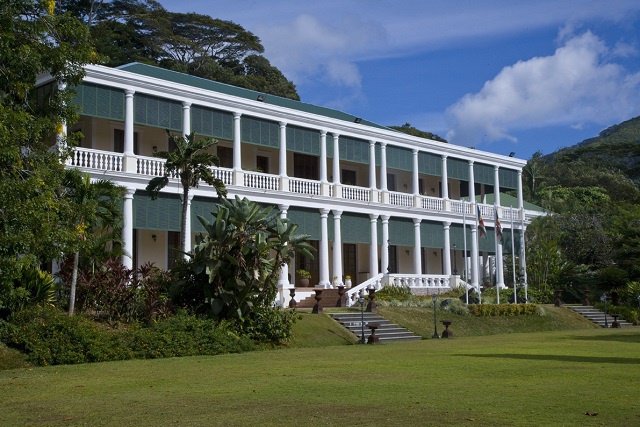
Photo: Gerard Larose, Seychelles Tourism Board via Wikimedia Commons, CC BY 4.0
VICTORIA, Seychelles, Seychelles marked United Nations Public Service Day 2026 on Tuesday with a high-level forum at the Savoy Resort that placed artificial intelligence, climate change, and demographic disruption at the centre of the country’s planning for its next 50 years, with President Patrick Herminie telling senior officials that the public service must become faster, more transparent, and built around the citizen rather than the institution.
The forum, organised by the Department of Public Administration in partnership with the Eastern and Southern African Management Institute (ESAMI), drew chief executives, public leaders, and most members of the Cabinet of Ministers. It carried the formal theme of reflecting on five decades of public service since independence in 1976, and what the next half-century demands from a small island state under pressure from outside shocks.
In his keynote, President Herminie set out three aspirations for the public service over the coming decade. The first was a service “unafraid of the future” that uses technology as a tool to serve people, encourages innovation from young officers, and shifts from a culture of compliance to one of initiative. The second was a service built on trust and accountability, where transparency strengthens collaboration and accountability is treated as a foundation rather than a threat. The third was leadership that develops leadership, by building institutions where officers are managed fairly, grievances are addressed promptly, and opportunities are awarded on merit.
He reminded officers that public resources belong to the people. Decisions must serve the public interest, not convenience. He illustrated the point with everyday examples: a mother needing a birth certificate, a business owner seeking a licence, a patient requiring clarity, an elderly citizen depending on their pension. “Every interaction either builds trust or erodes it,” he said. “There is no neutral ground.”
Speaking alongside the President, ESAMI’s Director of Research and Management Consultancy, Dr Henry Waruhiu, warned that traditional public administration models built on stability and slow-moving processes are increasingly out of date. Governments, he argued, must move from rigid systems to agile, adaptive structures capable of responding quickly to emerging challenges. Routine planning tools such as fixed five-year strategies, he added, are insufficient in a world defined by constant disruption. Climate change must be integrated across all sectors, or institutions risk irrelevance.
Dr Waruhiu pointed to accelerating geopolitical and economic instability, including supply chain disruptions, inflation, and shifting global alliances, which require governments to adopt real-time data, predictive modelling, and citizen-centred digital platforms. Younger generations now seek purpose-driven work, modern tools, and flexible environments, and rigid bureaucratic systems risk losing talent unless governments invest in continuous training and cultural change.
The Secretary of State for Cabinet Affairs and head of the Civil Service, Margaret Moumou, echoed the call for reform. She described public officers as guardians of public trust, stressing that decisions made today will shape the character and capability of the public service for decades. Looking ahead, she asked how technology, climate change, demographics, and global shifts will redefine the role of the state. “The future public service is being shaped by the decisions we make today,” she said. Her message was clear: leadership is not only about managing the present but preparing for the future.
The discussions sit within a wider global push on public sector innovation. The United Nations Department of Economic and Social Affairs continues to track digital transformation in public administration through its awards programme, while the UN Public Service Forum 2026 in Tbilisi is set to focus on transforming public institutions through innovation, accountability, participation, and inclusion. For Seychelles, the practical question is whether the political will expressed at the Savoy this week translates into budgeted reform in the years that follow.
Sources cited: Office of the President, Seychelles. Department of Public Administration, Seychelles. Eastern and Southern African Management Institute (ESAMI). The Guy Morel Institute, Seychelles. United Nations Department of Economic and Social Affairs, Public Service. UN Public Service Forum 2026 (Tbilisi).
Source: SN