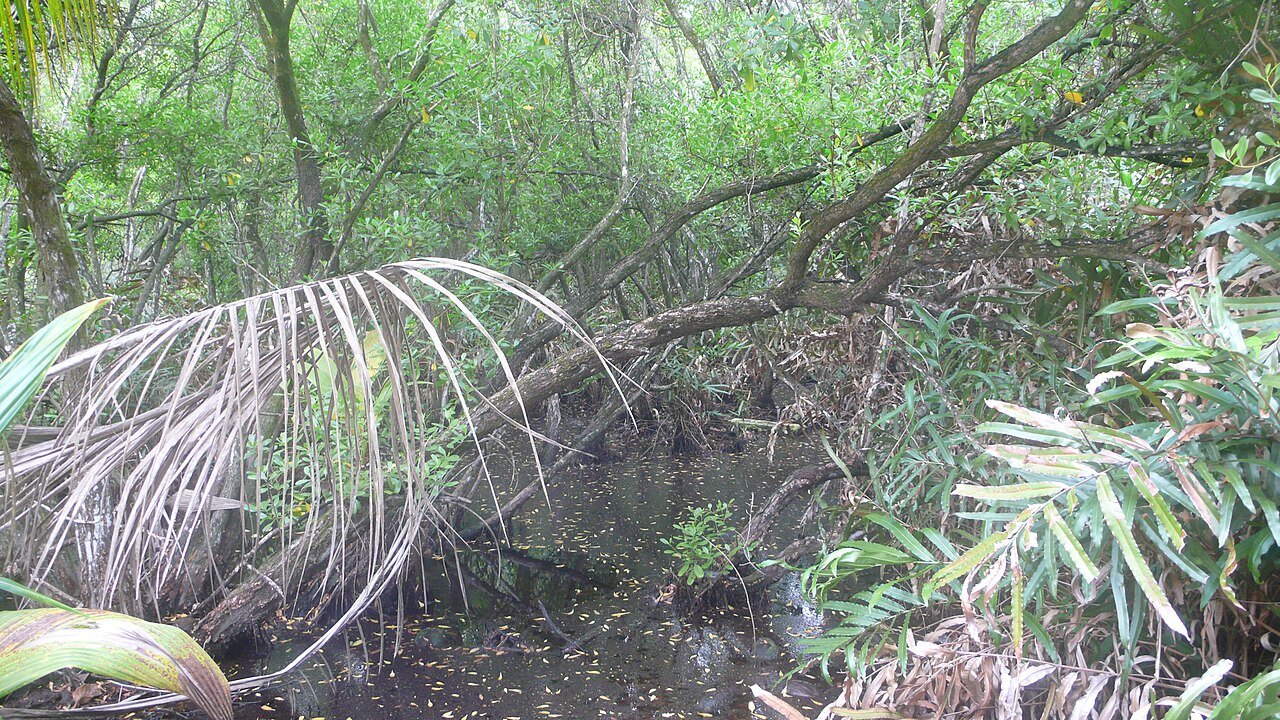
The National Assembly of Seychelles has begun mapping its own mangrove sanctuary, the first on-the-ground output of a project that aims to turn the country’s parliament into a recognised climate-resilient institution by the end of 2026.
The exercise took place on Saturday 13 June inside the parliamentary mangrove sanctuary and was organised by the staff-led Environmental Policy Implementation Committee (EPIC), the assembly’s in-house sustainability body. EPIC chair and deputy clerk Alexandria Faure led the day, working with a team of University of Seychelles environmental science graduates and a wider volunteer base drawn from Parley Seychelles and the SALS Green Footprints group.
The session opened with a project briefing by Faure and a technical session from conservationist Terence Vel, who is leading the underlying feasibility study. The methodology was deliberately simple: divide the volunteers into working groups, walk the sanctuary, measure and tag mangrove trees by hand and by GPS, and record what else was living in the canopy and the understorey. The data forms the baseline for the rest of the project.
EPIC members and the participating elected representatives found the field day instructive in ways the briefing alone could not have delivered. Hon. Gerry Sopha, one of the parliamentarians on site, said the exercise gave him a far more detailed picture of what the assembly is actually stewarding. “All parliamentarians should have the opportunity to be sensitised on mangrove ecosystems and climate mitigation and adaptation as legislators to ensure that we continue preserving the environment for the betterment of Seychelles,” he said.
The species list that came out of the day is short but representative. Volunteers recorded whelks, mangrove crabs, turtle doves, Seychelles kestrels and mynah birds. Most of the mangroves on site were red mangroves, identifiable by their distinctive prop-root systems and the easiest species for a mixed-experience volunteer group to measure reliably. The work also surfaced two problems the project will have to confront in the next phases. Plastic pollution was visible in pockets of the sanctuary, and invasive plant species had already moved into the margins. EPIC treasurer Gillian Samson, a regular on the committee’s clean-up days, said it was striking how easy it was to walk past the same species without registering them.
The project sits inside a wider Seychelles blue-carbon story that the international community has been watching. The country’s updated 2021 NDC committed to protecting at least 50 per cent of mangrove and seagrass ecosystems by 2025 and 100 per cent by 2030, with mangrove and seagrass carbon stocks to be folded into the national greenhouse gas inventory by 2025. National assessments put the country’s mangrove cover at roughly 2,200 hectares, of which about 80 per cent sits on Aldabra, storing close to 690,000 tonnes of organic carbon and sequestering around 14,000 tonnes of carbon dioxide a year. The International Union for Conservation of Nature has described these ecosystems as a critical test case for small-island blue-carbon finance.
For the National Assembly, the climate-resilient parliament project is being run as a demonstration of what a single institution can do at its own footprint. The wider work plan includes routine mangrove monitoring, capacity building for parliamentarians and staff, a carbon-footprint reduction programme, policy advocacy, and an honest assessment of what mangrove rehabilitation inside the parliamentary grounds can realistically deliver. Funding is coming from the Seychelles Conservation and Climate Adaptation Trust (SeyCCAT) under its Blue Grants Fund 8, and the work is expected to be wrapped up by the end of 2026. EPIC member Savrina Pirame said she hoped the mapping day would be the first of a longer string of staff-led conservation projects, starting with mangrove planting in the next phase.
Source: SN
Photo: V.Vergne, CC BY-SA 3.0, via Wikimedia Commons.