
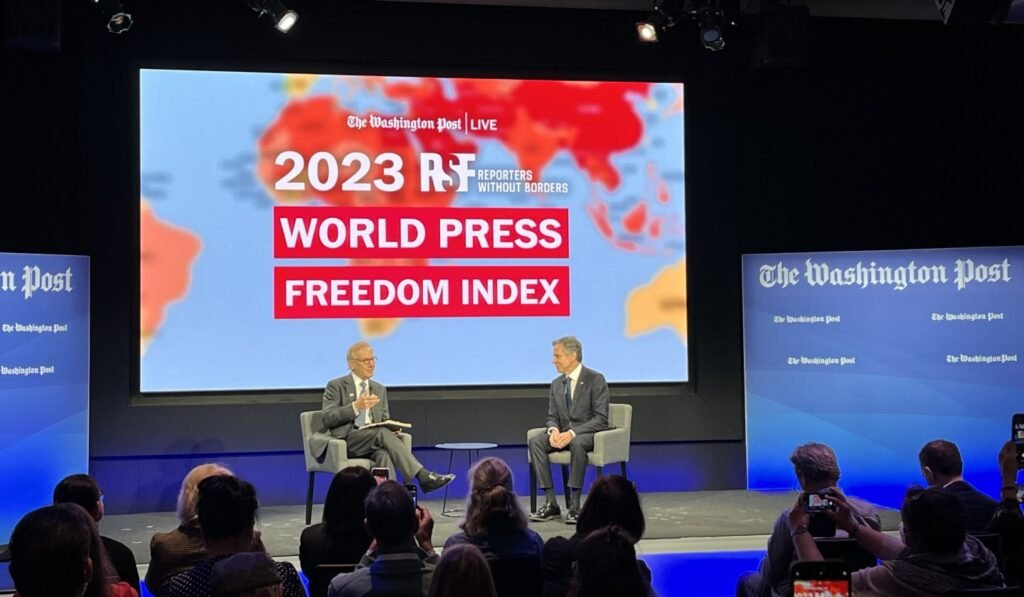
Victoria, Seychelles – Seychelles has made notable progress in global media freedom, climbing from 45th to 35th place out of 180 countries in the 2026 World Press Freedom Index published by Reporters Without Borders. Released on April 30 to mark World Press Freedom Day (May 3), the index evaluates countries based on five key indicators: political context, legal framework, economic context, sociocultural environment, and safety of journalists.
Seychelles achieved a score of 73.04 in 2026, placing it in the “satisfactory” category – a clear improvement from its 2025 score of 68.56, when it was classified as “problematic.” The upward movement reflects strengthening conditions for journalism and a generally supportive media environment in the country, according to Reporters Without Borders (RSF).
Progress – But at What Cost?
While the government is quick to celebrate this improvement, the report itself offers a more nuanced picture. RSF notes that “attacks on press freedom are quite rare in Seychelles,” but also referenced the 2023 expulsion of a Mauritian editor-in-chief whose newspaper had been critical of the authorities – highlighting that challenges still exist.
President Patrick Herminie praised the ranking in his World Press Freedom Day message, stating: “This progress reflects improving conditions for the media, where journalists are able to work with greater freedom and the press continues to be respected as a vital pillar of our democracy.”
State Media Dominance Continues
Yet this celebration comes just days after the government-owned NATION newspaper marked its 50th anniversary with Vice-President Sebastien Pillay presiding over the ceremony, and the Seychelles Broadcasting Corporation (SBC) inaugurated its new US$14 million Chinese-funded headquarters at Union Vale.
The uncomfortable reality is that state media in Seychelles continues to enjoy lavish government investment while independent media struggles with limited resources and access to government information. The question becomes: can press freedom truly flourish when the most established and well-funded media outlets remain under government control?
Selective Improvement?
Seychelles scored well on specific indicators: 90.28 on security (6th worldwide) and 77.32 on social indicator (38th worldwide). However, lower scores on political context (65.90), economic context (61.52), and legal framework (70.19) suggest that structural challenges remain.
The Media Association of Seychelles (MAS), in its World Press Freedom Day statement, called attention to “pressure on the media from various sources, be it political, religious or social” and urged practitioners to “avoid the common pitfalls which try to lure us from the job in hand.”
Global Context and Local Reality
Globally, Norway continues to rank first with 92.72 points, while Eritrea remains at the bottom with 23.45 points. France ranks 34th, the United Kingdom 35th, and the United States 45th – putting Seychelles ahead of the US in press freedom rankings, which some might view with skepticism.
For the first time in the index’s history, more than half of all countries fall into the “difficult” or “very serious” categories for press freedom. RSF attributes this decline to increasing political pressure, economic fragility in media sectors, and growing threats to journalists’ safety in many regions.
Moving Forward or Standing Still?
Former President Wavel Ramkalawan, in his World Press Freedom Day message, offered a more challenging perspective: “A free press is not a privilege granted by authority, it is a fundamental pillar of democracy that must be protected, exercised, and, when necessary, defended.”
He added that “press freedom must never be mistaken for freedom from responsibility” and called for a press that “speaks truth without hesitation, reports without bias, and holds all to account equally.”
Whether Seychelles’ improved ranking reflects genuine strengthening of press freedom or simply the absence of overt government crackdowns remains an open question. The true test will be whether the country’s media – particularly state-controlled outlets – can evolve to serve as genuine watchdogs holding power accountable, rather than amplifiers of government messaging.
Until then, climbing ten places in a global ranking is cause for acknowledgment, but hardly grounds for celebration.


