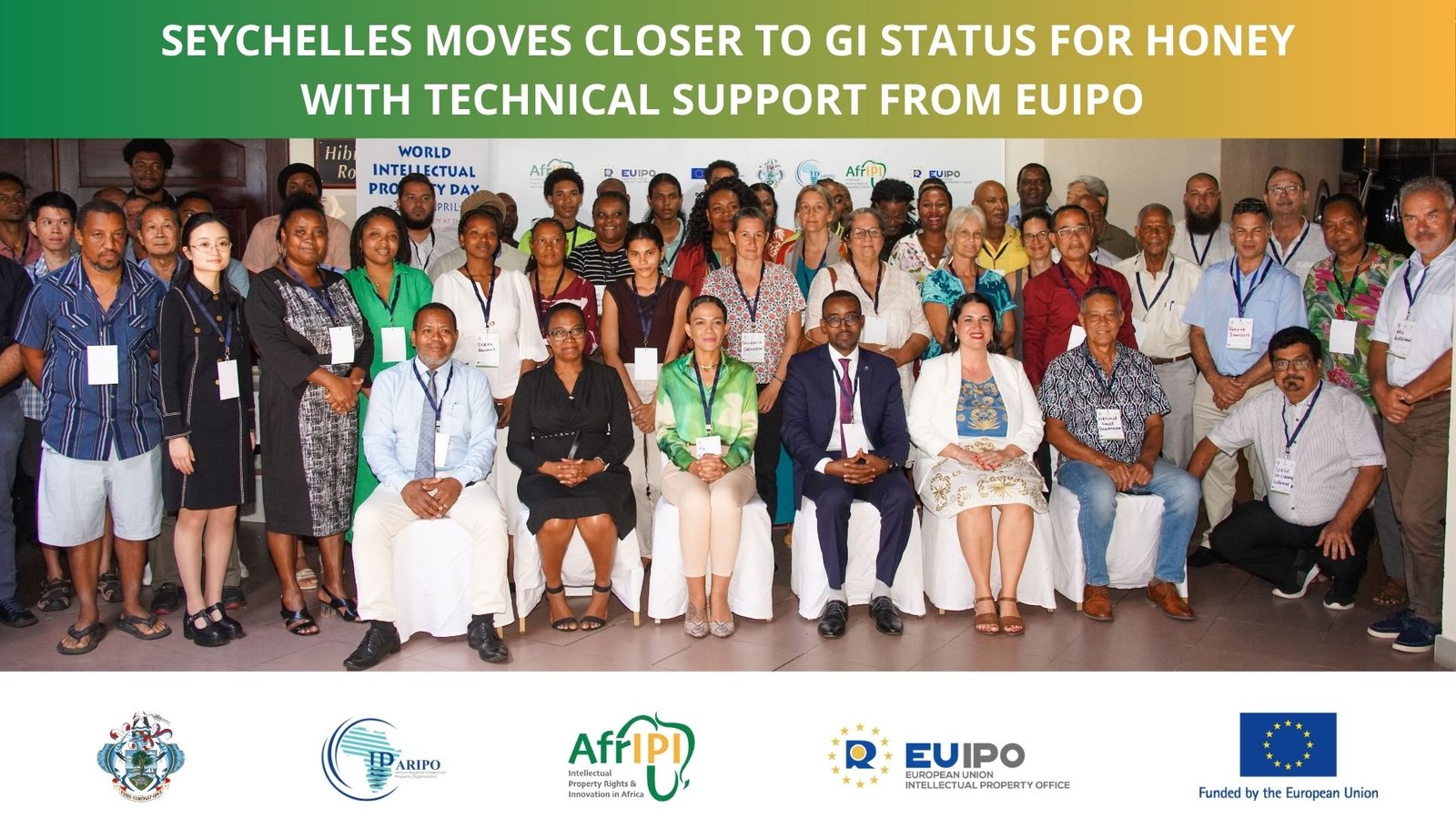
📷 Photo: AfrIPI Seychelles honey workshop (EUIPO AfrIPI project), 2025
Seychelles is moving closer to formal registration of its honey as a Geographical Indication, with a six week technical mission bringing a Togolese researcher into the Seychelles beekeeping community to document the distinctive qualities of the local product.
The mission, hosted by the Government of Seychelles and supported by the European Union Intellectual Property Office through the African Intellectual Property Rights and Innovation Project, is part of a process that began with a stakeholder workshop held on 26 to 27 June 2025 and is now moving into the documentation phase needed for a Geographical Indication application.
Sena Alban Soedji, a Togolese researcher with prior experience on Geographical Indication registration in West Africa, is working with local beekeepers and the Department of Agriculture to identify and verify the floral origins, organoleptic characteristics and production methods that distinguish Seychelles honey from competing products in the regional and international markets. The work draws on the model of the Oku white honey registration in Cameroon, which became one of the first African Geographical Indications in 2013.
Geographical Indications protect product names tied to a region’s identity, ensuring that only producers in the designated area can use the name and providing legal tools against imitation. According to a project announcement by AfrIPI, EUIPO, an international registration authority for craft and industrial Geographical Indications since 2025, is providing technical support to document honey’s distinct qualities and to set the stage for legal recognition.
For Seychelles, the case for protection rests on a combination of biodiversity and terroir. Seychelles honey is produced by an Africanised honey bee population in a remote archipelago environment, with floral sources drawn from coconut palm, takamaka, badamier and a range of endemic and introduced forest species. Documenting these floral and sensory links in a way that meets international Geographical Indication standards is the central technical task of the current mission, according to the AfrIPI workshop report.
The Seychelles beekeeping sector is small but has been growing in importance as part of broader agricultural diversification. The push for Geographical Indication status is intended to add value to existing production, open doors to higher end export markets and give local beekeepers a legal instrument against misleading labelling. The African Regional Intellectual Property Organization, headquartered in Harare, has been working alongside the government and the EUIPO since 2025 to scope the application, according to industry coverage of the workshop.
The Seychelles initiative also sits within a wider African push. The PAMPIG and PAMPIG 2 projects, hosted by the Organisation Africaine de la Propriété Intellectuelle and backed by the French Development Agency and CIRAD, the French agricultural research centre, have supported Geographical Indication registrations across the continent since 2008, according to a CIRAD research project description. Three products under PAMPIG have so far been registered as Geographical Indications: Oku white honey in Cameroon, Penja pepper and Ziama Macenta coffee, per a Frontiers in Forests and Global Change review of African forest honey Geographical Indication value chains.
The economics for Seychelles are modest but distinctive. Local honey sells at a premium relative to imported blends, and registration as a Geographical Indication would formalise that premium in the export market while strengthening consumer trust at home. Producers and the Department of Agriculture are also looking at the possibility of a code of practice covering hive management, harvesting and bottling standards, per the AfrIPI workshop summary.
The mission is scheduled to complete its technical findings by the end of August, with a draft application expected to be submitted to the African Regional Intellectual Property Organization before the end of the year.
Sources cited: Seychelles Moves Closer to GI Status for Honey With Technical Support From EUIPO, AfrIPI, June 2025 · Project to Support the Establishment of Geographical Indications in African Countries (PAMPIG 2), CIRAD UMR Innovation · To Label or Not? Governing the Costs and Benefits of Geographic Indication of an African Forest Honey Value Chain, Frontiers in Forests and Global Change, 2020.