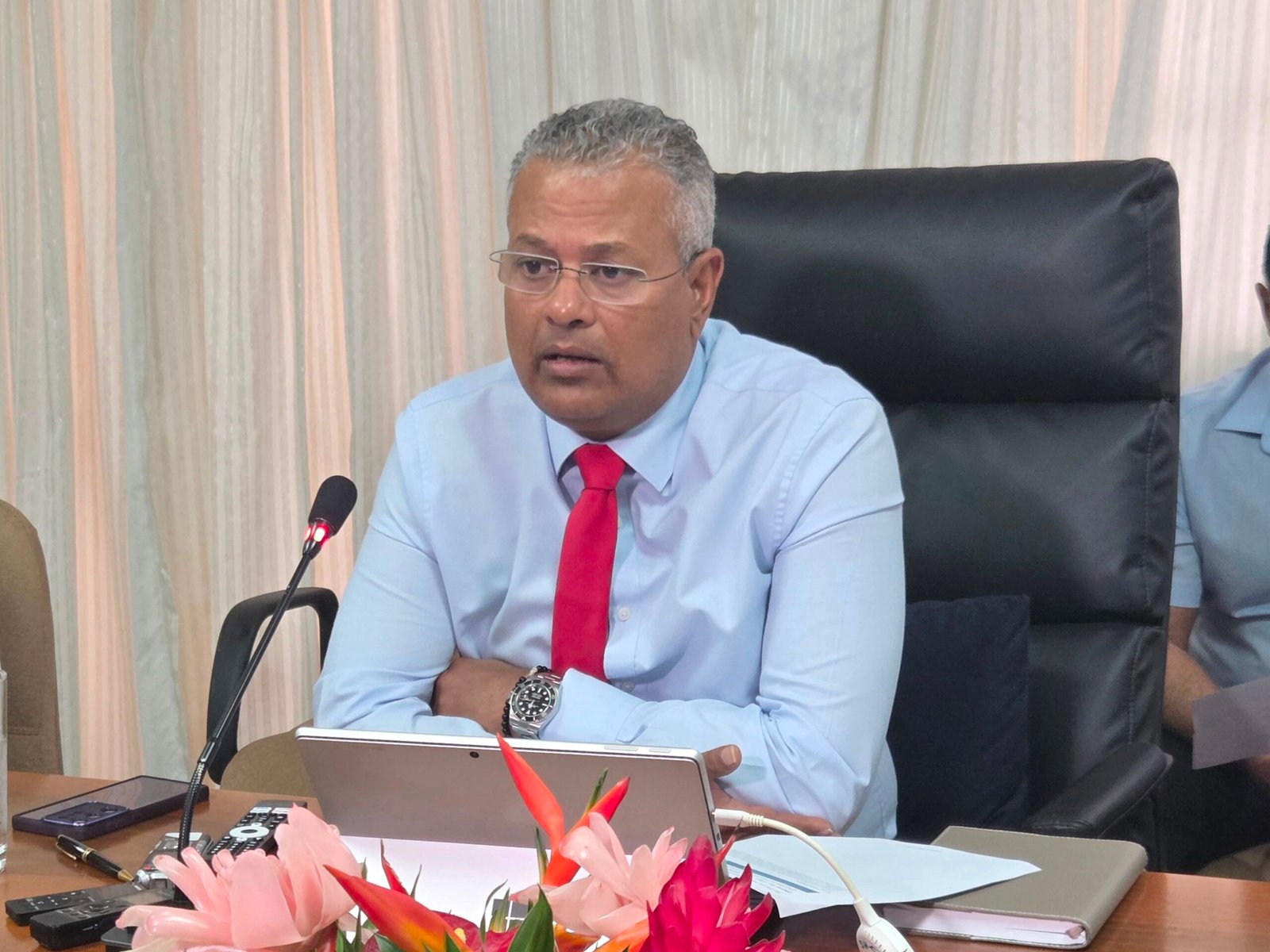
📷 Photo: State House Seychelles, 22 July 2026 (Vice-President Pillay at the Starlink operations press briefing)
VICTORIA, Seychelles — The Seychelles Revenue Commission is preparing to award a contract for a real-time e-invoicing platform, in what acting Commissioner General Fred Morel described this week as the most significant change to the country’s tax administration in a generation.
Speaking at a press briefing in Victoria on 23 July, Mr Morel said the procurement process began in March 2026 with a call for companies to participate. Following supplier presentations, SRC issued a request for proposals and shortlisted bidders. The successful bidder is expected to be announced once the evaluation is complete.
The new system will require VAT-registered businesses to issue and receive invoices electronically, with the platform transmitting transaction data to SRC in real time. Mr Morel said the goal is to bring VAT-registered businesses onto digital invoicing by the end of 2026, with the system likely to be extended to business tax in a second phase.
“We want to ensure that all VAT-registered businesses, regardless of size, are able to issue and receive invoices through the new platform,” Mr Morel said, adding that the commission had been engaging with service providers that supply point-of-sale and accounting software to ensure the transition is as smooth as possible.
Under existing legislation, VAT-registered businesses — generally those with annual turnover above SCR 150,000 — submit monthly VAT returns through SRC’s eFiling portal, and electronic billing solutions are already available. The new real-time e-invoicing platform will, however, mark a step change: invoices will be transmitted to SRC automatically as they are issued, with the agency able to monitor transactions more closely and shorten the gap between when a sale takes place and when the corresponding tax is declared.
Mr Morel said SRC had established a comprehensive governance structure to oversee the implementation, and was working closely with the Department of Information Communications Technology (DICT) and the Central Bank of Seychelles (the national monetary authority, separate from the SRC) on the regulatory and technical architecture. The platform, he added, is being designed to comply with international standards on data protection and to fit within the country’s existing digital public-infrastructure framework.
Real-time e-invoicing has been adopted by a growing number of countries, including several in Africa, as a means of improving tax compliance, reducing fraud and giving businesses faster access to input-tax credits. The African Tax Administration Forum has identified electronic invoicing as a key area for capacity-building among its members, and the World Bank has also tracked the move to digital invoicing across its member countries as part of its wider work on domestic resource mobilisation.
For Seychelles, where the tax base is narrow and the economy heavily reliant on tourism and fisheries, real-time e-invoicing is expected to improve SRC’s ability to detect under-reporting and to bring more of the informal economy into the formal system. Mr Morel said the commission was also planning an outreach programme to brief businesses, accountants and software vendors on the practical steps required ahead of the rollout.
Sources cited: Seychelles Revenue Commission (SRC); African Tax Administration Forum (ATAF) — e-invoicing capacity-building; World Bank — Financial Sector topic page on domestic resource mobilisation and digital tax administration.
- Perseverance and Children’s House Crowned Champions at Seychelles Interschool Chess Blitz
- Fourteen Public Sector Professionals Graduate from UniSey and Oxford Data Course
- Seychelles Hosts Fourth WADF All-African Artistic Dance Championship
-