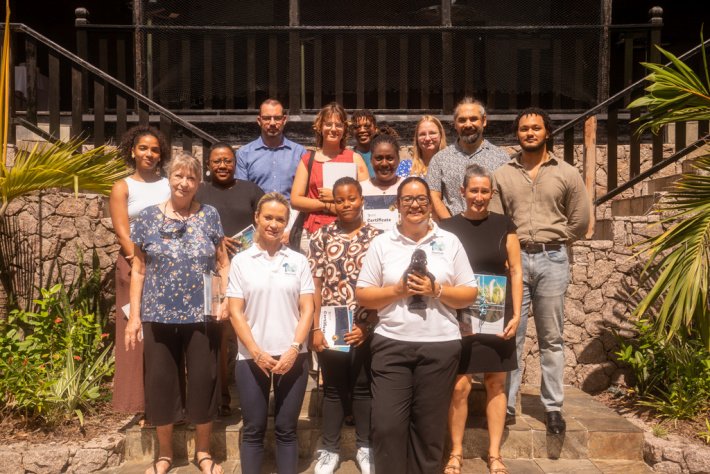
VICTORIA, Seychelles — The Seychelles Conservation and Climate Adaptation Trust has launched the ‘Status and Trend of Seychelles’ Coral Reefs 2026 Report’, one of the most comprehensive assessments of coral reef health ever conducted in the country. The ceremony, held on May 26, brought together Director General Rodney Quatre from the Ministry of Environment, Climate, Energy and Natural Resources; SeyCCAT chief executive Helena Sims; report authors Bee Ecological; and representatives from local organisations that contributed to the study.
Drawing on 3,778 observations from 285 survey sites over 32 years, the report provides the most complete picture of Seychelles’ reefs to date. Contributions from 11 dataset providers, including research institutions, government agencies, and conservation organisations, were consolidated into this single assessment. The findings are sobering: national coral cover stands at just 14 percent. Seychelles has endured three major climate-driven bleaching events in 1998, 2016, and 2024. The 1998 event caused an estimated 90 percent loss of live coral in the inner islands, reducing cover to around 3 percent.
Each successive event has left reefs with less recovery time, raising the risk of long-term collapse. Coral reefs are vital to Seychelles’ economy and food security. Reef-based tourism generates over US$51.5 million annually. Approximately 4,000 metric tonnes of reef fish are caught each year, sustaining livelihoods and local consumption.
The report was financed under SeyCCAT’s Ocean’s Resolve programme, funded by the Global Fund for Coral Reefs. The initiative supports reef-positive business development and stronger coordination among partners to safeguard Seychelles’ marine ecosystems. The ‘Status and Trend of Seychelles’ Coral Reefs 2026 Report’ is available for download at www.seyccat.org.
The findings underscore the urgent need for enhanced conservation efforts and climate adaptation strategies. The report will inform policy decisions and guide future marine protection initiatives. Seychelles’ marine biodiversity is a cornerstone of the nation’s identity and economic wellbeing.
SeyCCAT continues to work with partners to build resilience in Seychelles’ marine ecosystems.