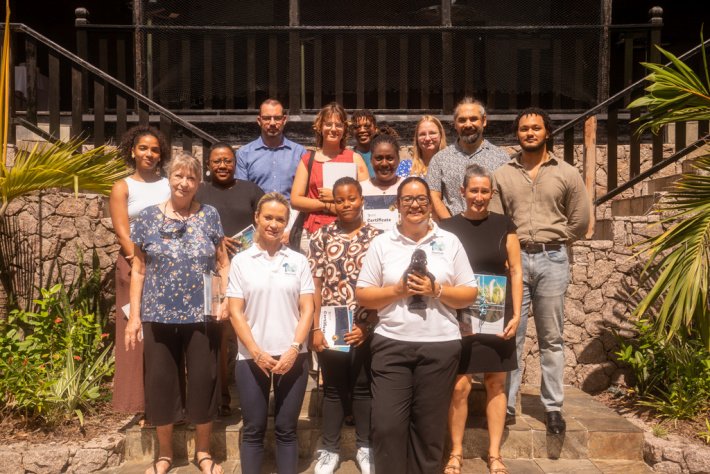
VICTORIA, Seychelles — The Central Bank of Seychelles has launched a strategic foresight initiative to strengthen long-term planning and resilience within the institution, partnering with the United Nations Institute for Training and Research, the United Nations Department of Economic and Social Affairs, and the United Nations Resident Coordinator’s Office for Mauritius and Seychelles. Thirty-one CBS management and technical staff participated in a one-day capacity-building workshop held at the Berjaya Beau Vallon Bay Resort and Casino on Thursday, designed to introduce concepts and tools for anticipating emerging risks and planning for multiple future scenarios. The training represents a recognition that traditional forecasting alone is insufficient in an increasingly interconnected and complex global environment.
For a small open economy like Seychelles, where external shocks can rapidly transmit through financial markets, tourism flows, and supply chains, the ability to anticipate and prepare for future risks is essential for monetary and financial stability. Strategic foresight provides tools for thinking beyond single expected outcomes and better preparing for emerging uncertainties, complementing rather than replacing traditional economic forecasting. The Central Bank’s investment in these capabilities signals a commitment to institutional resilience that ultimately benefits households and businesses through more stable financial conditions and better-informed policy responses to crises.
Addressing participants, UN Resident Coordinator for Mauritius and Seychelles Lisa Singh and CBS Governor Caroline Abel highlighted the growing relevance of strategic foresight for institutions including central banks, according to a press release. Governor Abel noted that for central banks, traditional forecasting alone is no longer sufficient, and strategic foresight provides an important complementary approach for thinking beyond single expected outcomes and better preparing for emerging risks and change. The workshop provided participants with the opportunity to discuss emerging risks and uncertainties affecting CBS, with particular emphasis on identifying early signals and drivers of change through practical interactive discussions and exercises.
Participants were introduced to key strategic foresight concepts and tools and their application within the CBS context, including signal scanning, scenario development, futures thinking, visioning, and backcasting techniques. The workshop is expected to support ongoing efforts to embed more forward-looking approaches within the Bank’s planning and decision-making processes, complementing CBS’s strategic planning efforts as the Bank continues to implement its 2025-2027 Strategic Plan. CBS is among several institutions benefiting from the initiative led by UN DESA, UNRCO and UNITAR to strengthen anticipatory governance and strategic foresight capacity across Seychelles’ public sector.
The adoption of strategic foresight approaches by the Central Bank reflects a broader shift toward more sophisticated risk management within Seychelles’ public sector institutions. As the country faces evolving challenges from climate change, technological disruption, and shifting global economic conditions, the ability to anticipate and prepare for multiple possible futures becomes increasingly valuable. The partnership with United Nations agencies provides access to international expertise and best practices in foresight methodology.
The Central Bank is expected to continue integrating foresight approaches into its strategic planning processes, building on the foundations established through this initial workshop.