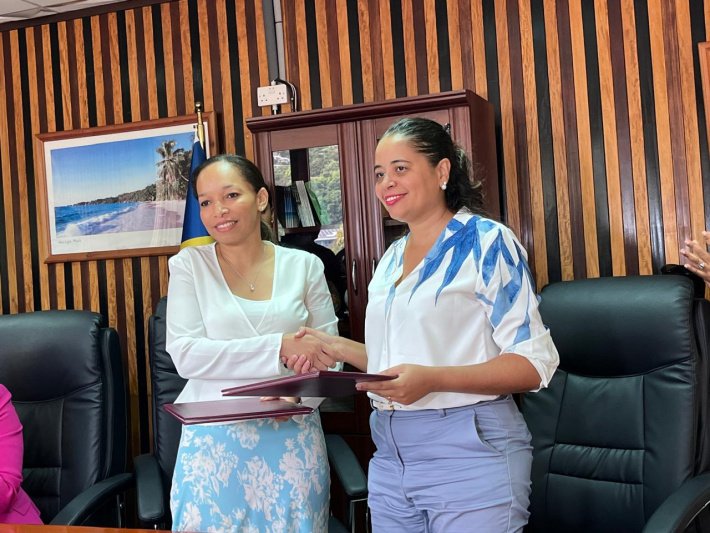
Victoria, Seychelles – The Ministry of Employment and Human Resource Planning announced Thursday it has signed a memorandum of understanding with eight private sector organizations, claiming the agreement will address “pressing labour market challenges” including youth unemployment.
The ceremonial signing at Independence House, officiated by Principal Secretary Susan Morel, brought together representatives from hotels and businesses including Cheval Blanc Seychelles, Canopy by Hilton, and several guesthouses. But beyond the photo opportunities and official statements, serious questions remain about whether this agreement will translate into actual employment opportunities or merely provide political cover for persistent joblessness.
More Paperwork, Fewer Jobs?
According to PS Morel, the MoU will facilitate “on-the-job training and employment opportunities” under existing government programs including the Skills Development Programme, My First Job scheme, and the Unemployment Relief Scheme. Between January and March 2026 alone, 501 participants registered across these platforms, with another 500 awaiting placement.
Critics, however, point out that these same programs have existed for years with mixed results. The fundamental question remains: why is a new MoU needed for programs that should already be functioning?
“This is typical government approach – create a ceremony, sign a document, issue a press release, but actual job creation? That’s another story,” said a local economist who preferred to remain anonymous. “We’ve had youth employment programs for a decade. If they worked, we wouldn’t need 500 people still waiting for placement.”
Private Sector Participation – Or Obligation?
The eight organizations that signed up – IVO Build Limited, Cheval Blanc Seychelles, Canopy by Hilton, Mango House, Marilla Seychelles, Story Seychelles, Gift Hub, and Gardens Hill Resort and Spa – committed to offering training and employment through the government schemes.
What the ministry didn’t disclose is what, if any, incentives these businesses receive for participation. Are there tax breaks? Subsidies? Or is this purely voluntary corporate social responsibility?
The lack of transparency raises concerns about whether this is a genuine partnership or political theater designed to make the government appear proactive on employment while shifting the burden to the private sector.
Skills Development or Cheap Labour?
The MoU emphasizes “on-the-job training” – a phrase that can mean either valuable skills development or, more cynically, a pipeline of subsidized labor for businesses without guaranteed permanent employment.
PS Morel stated the ministry will “conduct follow-ups and performance reviews to ensure obligations are met by both parties,” but provided no details on accountability mechanisms, success metrics, or what happens if businesses fail to deliver promised opportunities.
Three Participants at a Signing – For the Optics
In what appeared to be a carefully staged photo opportunity, three participants from the ministry’s employment programs attended the signing ceremony, “symbolising the direct impact of the agreement on jobseekers.”
The symbolism is heavy-handed: look, here are three people who might benefit from this MoU. But with 500 still waiting for placement and youth unemployment remaining a persistent challenge, three photogenic participants hardly constitute a success story.
The Real Question Nobody’s Asking
PS Morel encouraged the public to “seize the opportunity to develop skills” and urged more employers to sign similar agreements. But the real question is: why aren’t businesses hiring more Seychellois without needing government MOUs?
Is it a skills gap? A wage expectation gap? Or are businesses simply finding it more profitable to rely on government-subsidized training schemes rather than invest in their workforce directly?
The government’s response to unemployment has increasingly relied on programs, schemes, and now MOUs. What’s missing is a comprehensive economic strategy that creates conditions for sustainable, well-paying jobs in the first place.
This latest signing may make for good optics during an election cycle, but Seychellois youth waiting for real employment opportunities deserve more than ceremony and paperwork – they deserve jobs with dignity, security, and fair wages.
Whether this MoU delivers that, or simply provides eight businesses with access to government-subsidized labor, remains to be seen.