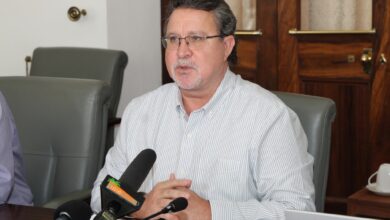
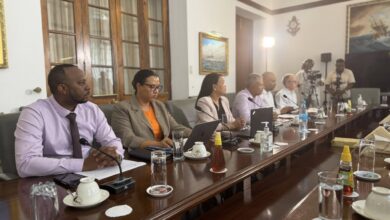
The President of the Republic, Dr Patrick Herminie, today convened and chaired the first meeting of the Economic Advisory Council at State House, formalising a key policy commitment to institutionalise high-level, independent economic advisory capacity within the Executive.
The establishment of the Council gives effect to the Government’s undertaking to reinforce macroeconomic policy formulation through structured engagement with experienced private-sector practitioners. It is designed to enhance the analytical depth, strategic coherence, and forward-looking orientation of economic decision-making at the highest level of Government.
Comprising 11 members appointed in their personal capacity, the Council brings together senior professionals with demonstrated expertise across sectors that materially influence national economic performance. Members are selected for their recognised insight, market knowledge, and practical experience in navigating complex economic environments. In his remarks, the President of the Republic, Dr. Patrick Herminie, higlighted the importance of broad-based economic insight in national decision-making, noting that no government, regardless of its capacity, holds all the answers.
He emphasised that in a small and highly open economy such as Seychelles, exposed to external shocks, constrained by scale, and shaped by global forces beyond national control, it is imperative to draw on the widest possible range of credible economic perspectives.
President Herminie further described the Council as an instrument of disciplined reflection, serving as a forum where experience meets policy, where practical insight complements institutional analysis, and where the quality of economic decision-making is strengthened through informed and independent deliberation.
The Council’s core function is to serve as an independent macroeconomic sounding board to the President, providing non-binding, evidence-informed advice on defined strategic economic questions. Its mandate is explicitly non-executive: it does not exercise supervisory authority, assume operational responsibilities, or duplicate the functions of existing public institutions. Rather, it complements the current institutional architecture by introducing private-sector-informed perspectives into macroeconomic deliberations.
Deliberations of the Council will be agenda-driven and focused on priority macro-strategic issues as determined by the President. Where specialised technical input is required, the Council may engage additional expertise from industry and academia to support rigorous assessment and policy consideration.
The Council is composed of the following members:
- Mr. Christopher Mancham Gill
- Dr. Gerald Adonis
- Mr. Bertrand Rassool
- Mr. Gafoor Yakub
- Ms. Angelique Antat
- Captain David Savy
- Mr. Louis Bossy
- Mr. Suketu Patel
- Mr. Jean Weeling-Lee
- Ms. Louanna Pillay
- Ms. Jennifer Vel, Chief of Staff and Economic Advisor to the President, who serves as Secretary to the Council
The operationalisation of the Economic Advisory Council represents a concrete step in advancing the Government’s long-term economic agenda. It reinforces a policy framework anchored in macroeconomic stability, private sector partnership, and institutional resilience, with the objective of supporting sustainable, inclusive growth over the medium to long term.
By embedding disciplined, independent economic judgement into executive-level decision-making processes, the Council is expected to strengthen policy credibility, improve responsiveness to evolving economic conditions, and contribute to the optimisation of national economic outcomes.
The inaugural meeting marks the transition from policy commitment to implementation, establishing a platform for continuous, high-level economic advisory engagement in support of Seychelles’ development trajectory.
-

-
-
-